

Grievances, structured.
Helping a large municipal corporation classify, route and score every citizen complaint for SLA risk the moment it arrives.
- Industry: Municipal Corporation
- Service line: NLP & Classification, SLA-Risk Prediction
- Solution: Grievance Intelligence
- Engagement: Intelligence layer over the existing grievance system
Results at a glance
- 5 intake channels feeding the same classification logic
- 7 civic issue types, from roads to public health
- 8 operational gains in how complaints moved
Challenge
A broken streetlight should not need four departments to fix.
Our client, a large municipal corporation, received citizen complaints through mobile apps, web portals, call centres, control rooms and departmental systems, each in its own format. Ambiguous, multilingual descriptions were misrouted, transferred between departments, and counted as breaches only after the fact.
- A transfer, not a resolution. Incorrect classification moved complaints between departments while their SLA clocks kept running.
- Urgency found too late. High-risk and urgent complaints were not always identified early, and repeat complaints were registered again and again.
- Status without explanation. Static reports showed what had breached, not what was about to, and department performance was measured after delays occurred.
Solution
We built a Grievance Intelligence module that classifies, routes and scores every complaint the moment it arrives, alongside the corporation’s existing grievance-management system.
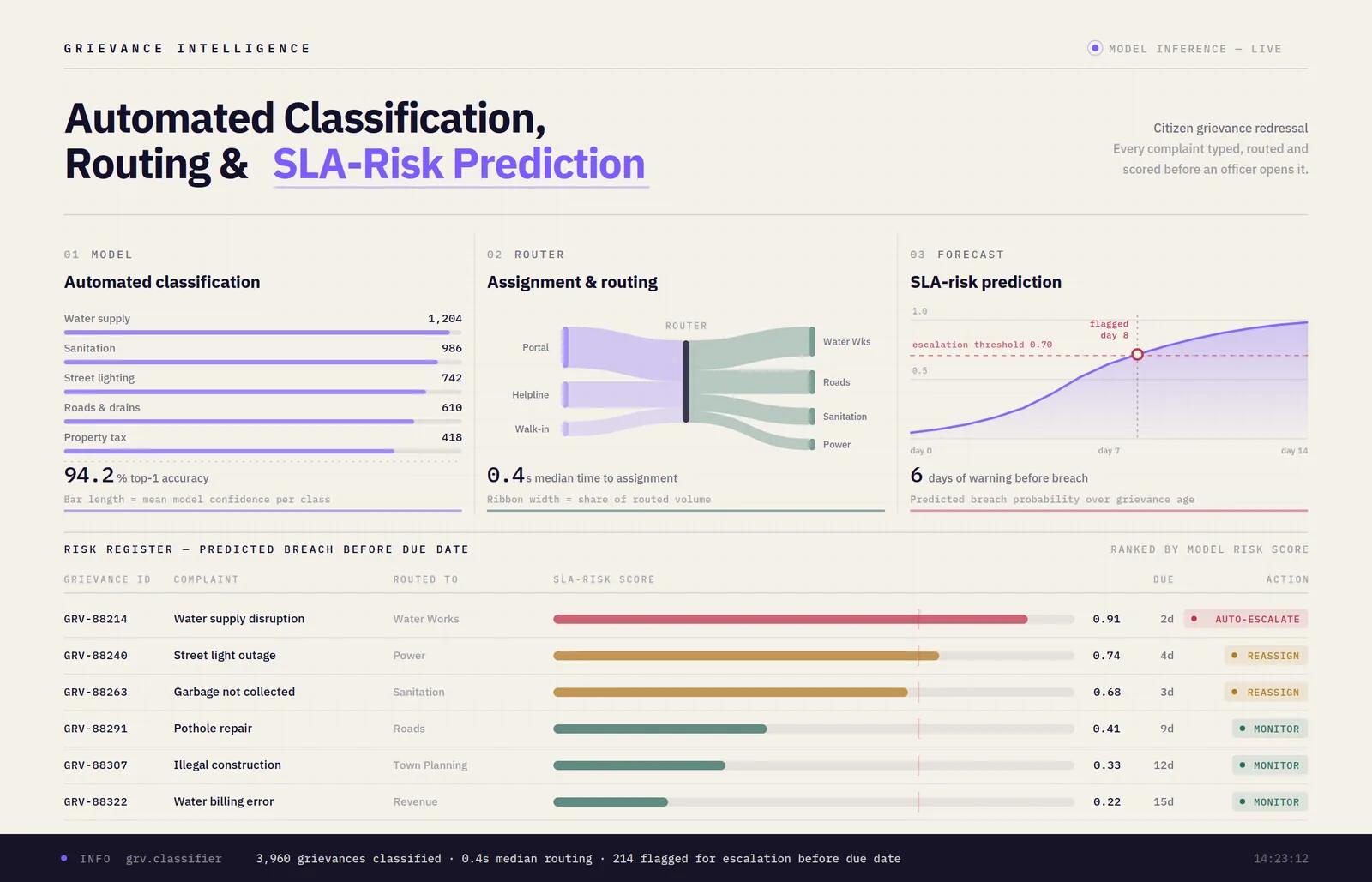
- Read the complaint text. Natural-language processing and configurable municipal rules predicted category and subcategory directly from the citizen’s words, in the language filed.
- Recommend the owner. Department and officer-routing recommendations, priority and urgency detection, and duplicate and related-complaint detection ran in one pass.
- Score risk continuously. SLA-risk scoring and ageing monitoring tracked every case across its lifecycle, feeding department dashboards and exception queues for human review.
Impact
Grievance management shifted from retrospective reporting to proactive intervention: officials could see which complaints were likely to breach and where preventive action was still possible.
- Less manual triage. First-level triage effort dropped and classification became consistent, so routing to the right department started sooner.
- Hotspots, not isolated incidents. Geographic and thematic clusters exposed recurring civic problems, with daily action lists for responsible officials.
- Structured data from raw text. Unstructured citizen descriptions became a consistent foundation for every downstream report.
Capabilities
Natural-Language Processing · Classification Systems · Workflow Intelligence · SLA-Risk Prediction · Multilingual AI · Municipal Operations · Human-in-the-Loop Automation
Questions
What is Grievance Intelligence?
Grievance Intelligence is an AI module that classifies citizen complaints, recommends the responsible department and predicts which complaints are at risk of breaching their SLA before the breach happens.
Which complaint channels does it handle?
Mobile apps, web portals, call centres, control rooms and departmental systems, across issues such as roads, sanitation, drainage, streetlights, water supply, encroachments and public health.
Does it replace the existing grievance system?
No. It works alongside the corporation’s existing grievance-management system and sends cases that need judgment to human exception queues.
Every municipal corporation already receives the complaints a good grievance system needs to act on. What most are missing is a way to see which ones are heading toward a breach before that breach happens.
allcontext.ai, from the Grievance Intelligence case study
Finding out about SLA breaches after they happen?
See how complaint-level risk scoring gives officials time to act. Book a discovery call or write to hello@allcontext.ai.