

Recovery, spoken.
Navi Vani (NAVI-VANI) is Navi Mumbai Municipal Corporation’s (NMMC) AI-led citizen engagement assistant, built by AllContext.AI. Navi Vani uses six connected AI agents to decide which property owners to contact, why and when, speaks to them in Marathi, Hindi or English, and links every payment back to the conversation that preceded it. It is a SKOCH Award nominee.
- Client: Navi Mumbai Municipal Corporation (NMMC)
- Industry: Municipal Corporation
- Solution: Navi Vani, with voice engagement by HaHello
- Engagement: Concept Dec 2025, ~30-day prototype, 7-day live pilot Mar 2026
Navi Vani pilot results at a glance
- 30,171 calls made in the 7-day live pilot
- 17,623 properties called
- 2,000 properties paid after the call
- ₹88.84 crore collected from called properties during the pilot period
- ₹11.54 crore from long-term defaulters who had not paid in three to five years or more
Figures from the March 2026 live pilot.
Watch Navi Vani in action
The challenge NMMC faced
Thousands of citizens, a few days to reach them.
NMMC wanted to improve property-tax recovery by reaching thousands of citizens within a limited collection window. The existing process depended on manual calling, field teams, notices and fragmented follow-up, and there was no scalable way to conduct personalised outreach across a large number of properties.
- Manual calling could not scale. Calling needed significant time and staffing, and call-centre capacity was limited during peak collection periods.
- Many languages, one script. Citizens preferred different languages, which the existing process could not always accommodate.
- Outreach and payment data apart. Contact outcomes were not captured consistently, missed calls were hard to track, and payment data never met outreach data.
How Navi Vani works: six AI agents
Navi Vani works as an engagement layer over NMMC’s existing municipal systems, which remain the source of record for every transaction. Six agents divide the work:
- Property research agent. Builds a picture of each property from municipal tax records: dues, arrears and payment history.
- Segmentation agent. Groups properties so each segment gets the right outreach.
- Recovery propensity agent. Estimates how likely each property is to pay, so effort goes where it will recover the most.
- Next best action agent. Decides who to call, why and when, and what should happen after the call.
- Multilingual voice engagement agent (HaHello). Holds the conversations in Marathi, Hindi or English, up to 50 calls at a time; reminds each owner of their due amount, captures payment commitments and callback requests, sends WhatsApp follow-ups, and hands cases to municipal officers when a human is needed.
- Revenue attribution agent. Links each payment back to the intervention that preceded it, so the corporation can see what actually worked.
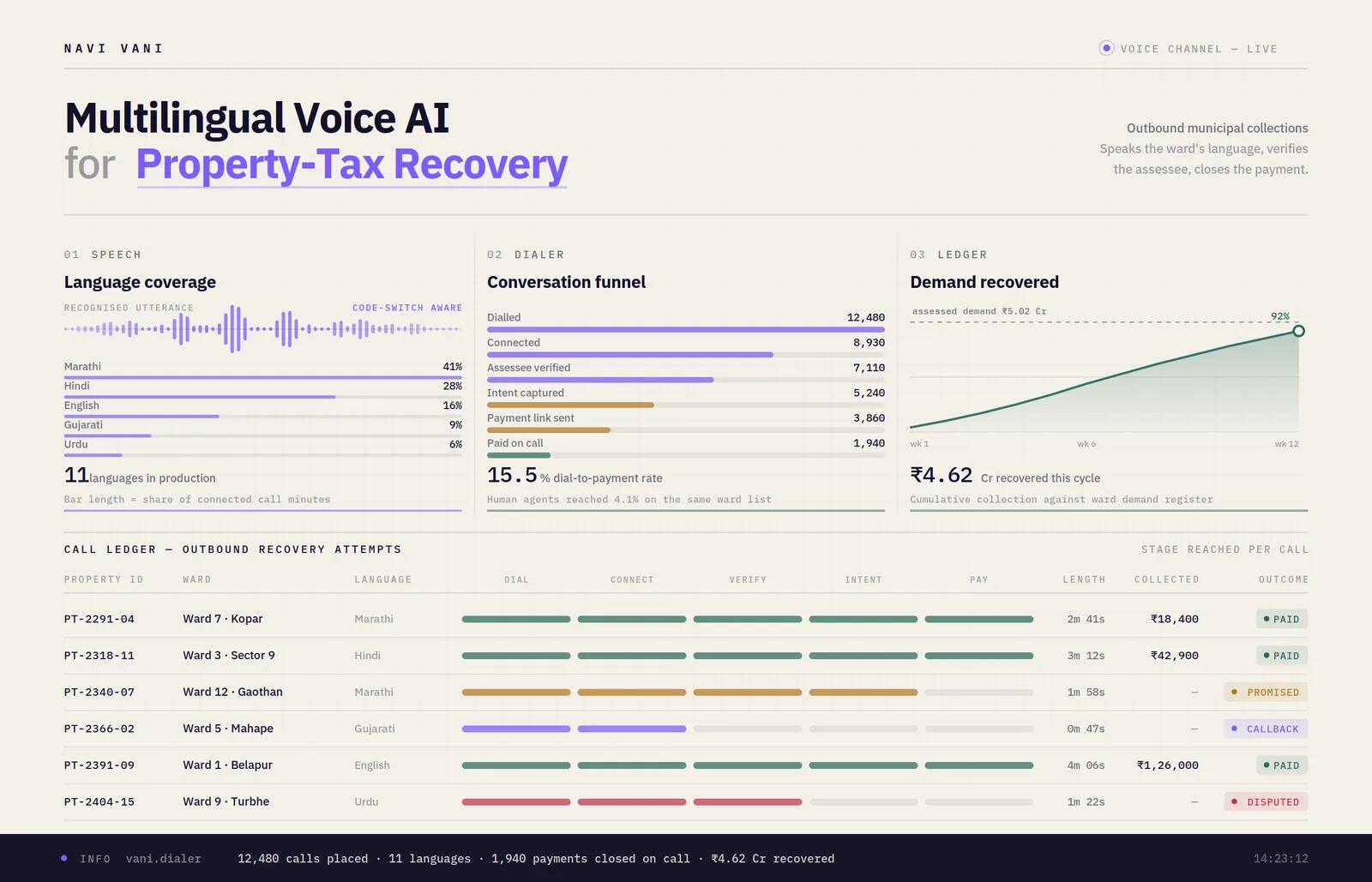
Navi Vani results for NMMC
In the 7-day live pilot in March 2026, Navi Vani made 30,171 calls to 17,623 properties. 2,000 properties paid after the call, and ₹88.84 crore was collected from called properties during the pilot period, including ₹11.54 crore from owners who had not paid in three to five years or more.
- Long-term defaulters reached. ₹11.54 crore came from properties that had not paid for three to five years or more.
- Thousands reached in days. NMMC contacted thousands of taxpayers within a few days and gained structured campaign data for every follow-up.
- A telecalling team becomes 3 to 5 operators. Work that would need a telecalling team of around 50 now runs with 3 to 5 campaign operators, with officers retained for escalation and high-value recovery.
Recognition
Navi Vani has been nominated for the SKOCH Award. See the Navi Mumbai Municipal Corporation entry on SKOCH.
Navi Vani in the news
- Free Press Journal: NMMC Records ₹876 Crore Property Tax Collection In FY26, Highest Ever Recovery (1 April 2026). The report credits technology-led recovery, including AI-powered calling, for NMMC’s highest-ever collection.
- Outlook Business: Navi Mumbai Civic Body Nets Record ₹434 Cr in Property Tax in Q1 of 2026-27 (6 July 2026).
- SKOCH: Navi Mumbai Municipal Corporation, Beacon of Hope exhibition entry.
Capabilities
Agentic AI · Conversational AI · Multilingual Voice Systems · Municipal Revenue Recovery · Revenue Attribution · Workflow Automation · Data Integration · Citizen Engagement · Rapid Public-Sector Deployment
Navi Vani FAQ
What is Navi Vani?
Navi Vani (NAVI-VANI) is Navi Mumbai Municipal Corporation’s AI-led citizen engagement assistant, built by AllContext.AI. It uses six AI agents and multilingual voice calls to help NMMC recover property tax.
Who built Navi Vani?
AllContext.AI designed and built Navi Vani with NMMC. Its voice conversations run on HaHello, AllContext.AI’s multilingual voice runtime.
What results did the Navi Vani pilot achieve?
In a 7-day live pilot in March 2026, Navi Vani made 30,171 calls to 17,623 properties. 2,000 properties paid after the call, and ₹88.84 crore was collected from called properties during the pilot period, including ₹11.54 crore from long-term defaulters.
Which languages does Navi Vani speak?
Marathi, Hindi and English, with up to 50 calls running at the same time.
Does Navi Vani replace municipal staff?
No. Navi Vani handles first-level outreach, while 3 to 5 campaign operators and NMMC officers handle escalation, resolution and high-value recovery.
More on Navi Vani
- Navi Vani video on YouTube
- The voice behind Navi Vani, on HaHello
- Navi Vani: AI agents for municipal revenue, by Kshitij Vishnu
- SKOCH Award entry: Navi Mumbai Municipal Corporation
Most municipal corporations already have the taxpayer records a great recovery campaign needs. What they lack is a way to speak to every one of those citizens personally, in their own language, within the days a collection window actually allows.
AllContext.AI, from the Navi Vani case study
Collection window closing faster than your team can dial?
See how Navi Vani’s agents reach every property owner in days. Book a discovery call or write to hello@allcontext.ai.