

Revenue, structured.
Helping a large municipal corporation rank property-tax defaulters by recoverable value through a read-only layer over its existing ERP.
- Industry: Municipal Corporation
- Service line: Decision Intelligence, Data Engineering
- Solution: Property-Tax Intelligence
- Engagement: Read-only integration over the municipal ERP
Results at a glance
- 9 key intelligence views drawn from one record
- 10 solution components, raw tables to ranked lists
- 0 core tax systems replaced
Challenge
The data to recover crores was already in the system. Nobody could see it ranked.
Our client, a large municipal corporation, already held detailed assessments, demand, collections and arrears in its municipal ERP. This was not a data-scarcity problem but a synthesis problem: nothing translated property records into a portfolio-wide view of where recovery would pay.
- Answered from scratch every time. Questions about where recoverable value sat required extensive manual analysis, repeated whenever someone needed the answer.
- History, not a next action. Reports showed last quarter’s totals, not a list of the ten properties a field team should visit this week.
- Data spread across tables. Property-tax data lived across many database tables, collection sources and operational reports.
Solution
We built a property-tax intelligence solution that connects to the existing database through a read-only integration, adding a decision layer above the ERP rather than inside it.
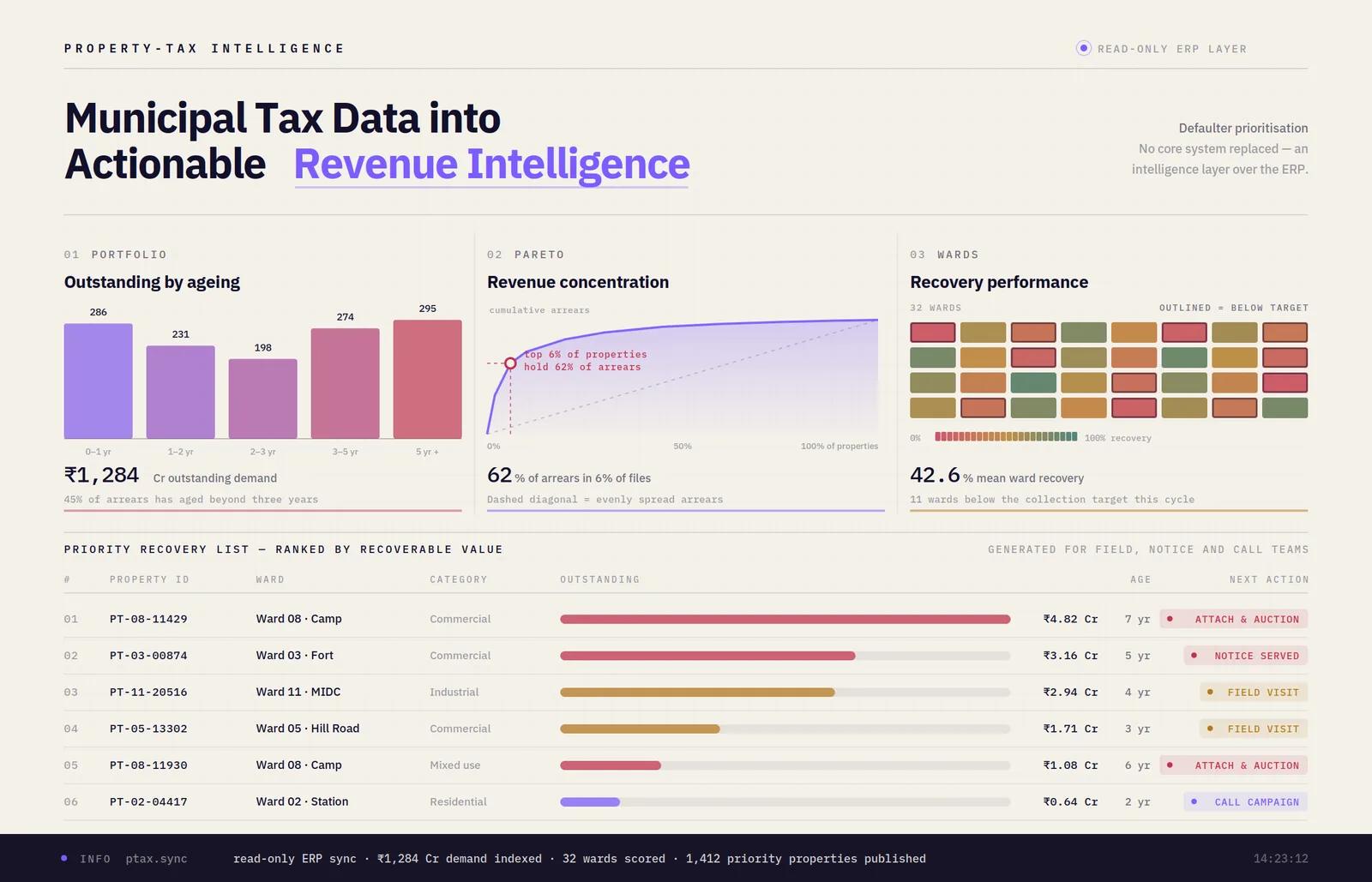
- One record per property. Custom ingestion pipelines consolidated multiple collection and payment sources into one coherent record per property.
- Ranked defaulters. Demand, collection and arrears analysis fed defaulter ranking and prioritisation models, segmented into actionable recovery buckets.
- Views for every audience. Ward, zone and category dashboards, ageing and Pareto analysis, drill-down to individual properties, and APIs for downstream applications.
Impact
Recovery teams moved from static historical reports to prioritised, targeted lists for field visits, calls, notices and digital outreach.
- Revenue concentration made visible. The Pareto view showed a small percentile of defaulters accounting for a disproportionate share of what was owed.
- Less spreadsheet dependency. A unified revenue-intelligence view replaced manually prepared spreadsheets and static reports.
- A foundation for what comes next. The same layer supports predictive recovery scoring and automated citizen outreach, without a second migration.
Capabilities
Municipal Revenue Intelligence · Data Engineering · Database Integration · Decision-Support Systems · Defaulter Prioritisation · Full-Stack Product Development · AI-Enabled Public-Sector Transformation
Questions
What is property-tax defaulter prioritisation?
It ranks properties by recoverable value and recovery likelihood, so field teams, calls and notices go first to the properties that matter most.
Does the municipal ERP need to be replaced?
No. The intelligence layer connects to the existing tax database through a read-only integration and leaves the core system unchanged.
What views do officials get?
Top defaulters, ward and zone performance, arrears by ageing bucket, revenue concentration (Pareto) views and drill-down to individual properties.
Most municipal corporations already have the data a good recovery strategy needs. This layer gave them a shared, ranked view of where limited time would recover the most revenue.
allcontext.ai, from the Property-Tax Intelligence case study
Sitting on tax data that never tells you who to call first?
See how a read-only layer turns your ERP into a ranked recovery list. Book a discovery call or write to hello@allcontext.ai.