
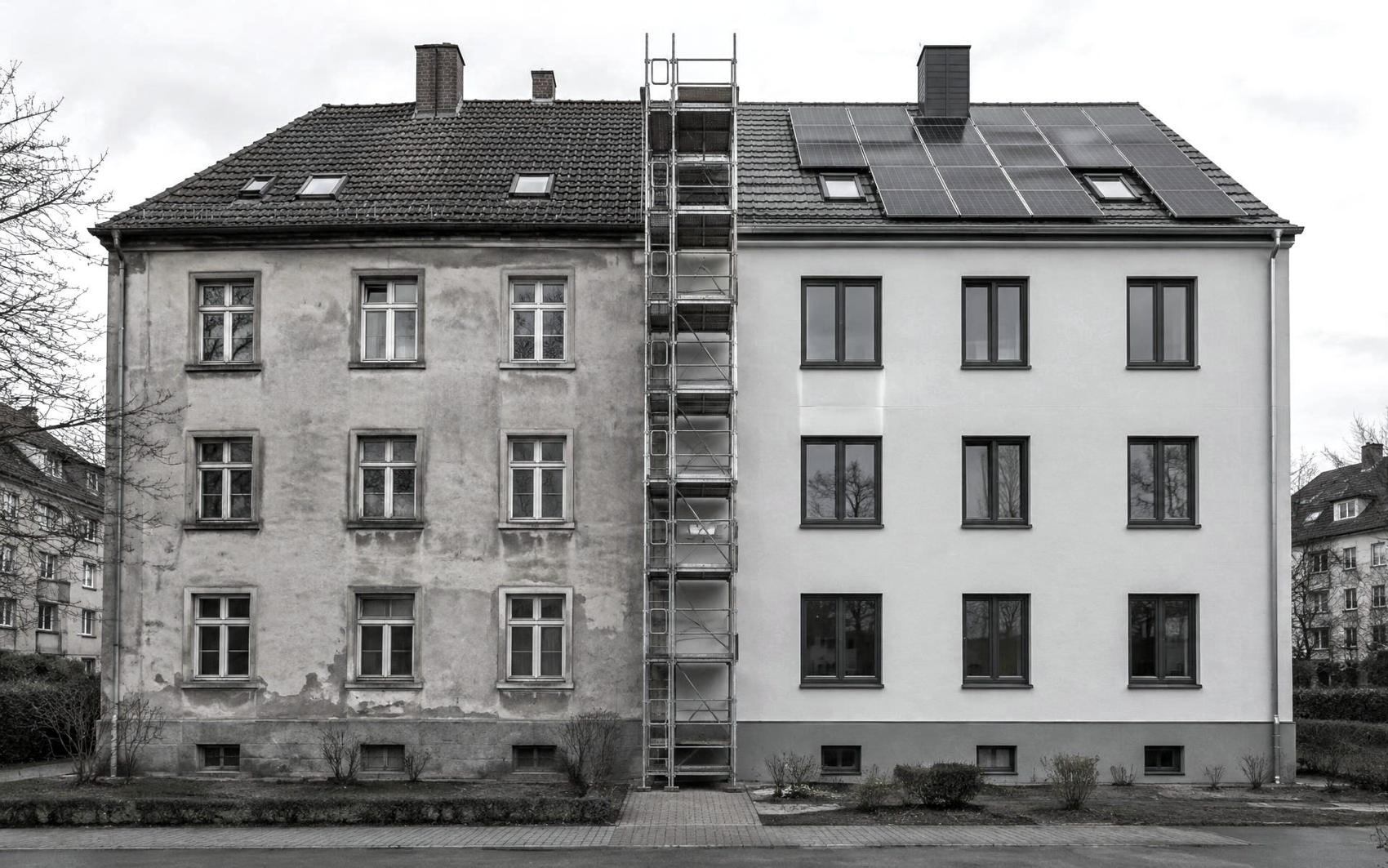
Decarbonisation, structured.
Helping a large property-portfolio owner estimate carbon performance where EPC data is missing and rank every building by renovation opportunity.
- Industry: Sustainability & Real Estate
- Service line: Machine Learning, ESG Analytics
- Solution: Smart Green Renovation
- Engagement: Random Forest Regression, Python and Scikit-learn
Results at a glance
- 25.8% reduction in Mean Absolute Error, from 11.08 to 8.22
- €3.7–4M estimated business value over three years
- 13 categories of building data modelled
Challenge
You cannot inspect thousands of buildings one at a time.
Our client, an organisation managing an extensive property portfolio, held thousands of buildings with patchy Energy Performance Certificate data. A portfolio of thousands cannot be walked one building at a time, and formal assessment does not scale.
- Incomplete records. Energy ratings, emissions, insulation quality and renovation potential were often missing or outdated.
- Expensive at scale. Physical inspection and specialist assessors work building by building, slowly and inconsistently.
- Hard to prioritise. Without comparable estimates, renovation budgets could not be ranked against expected carbon impact.
Solution
We built a machine-learning framework that estimates performance where data is incomplete and ranks renovation opportunity across the whole portfolio. It informs formal assessment, it does not replace it.
Mean Absolute Error fell from 11.08 (baseline) to 8.22 (optimised) after feature engineering and tuning: −25.8% error within the same model family.
- Consolidate and engineer. Building, property and energy datasets were consolidated, quality-checked and feature-engineered across thirteen input categories.
- Train a Random Forest. Chosen for mixed data, non-linear relationships, robustness to outliers and feature-importance explainability.
- Estimate, compare, rank. Proxy emission estimates fed scenario comparisons and a comparable renovation-opportunity score for every building.
Impact
Iterative optimisation cut Mean Absolute Error from 11.08 to 8.22, enough confidence to use the model for portfolio-level prioritisation.
- €3.7 to €4 million in value. Estimated over three years, linked to better decisions, efficiency, prioritisation and scale.
- Budget where it goes furthest. Buildings ranked by expected carbon reduction, with the full portfolio segmented by energy efficiency.
- Ready to extend. Designed for retraining on new EPC data, with scenario, climate-risk and payback modelling next.
Capabilities
Machine Learning · Random Forest Regression · Feature Engineering · Sustainability Analytics · Decision Support · Business-Value Assessment
Questions
What is Smart Green Renovation?
It is a machine-learning framework that estimates building energy and carbon performance where EPC data is missing, and ranks a whole property portfolio by renovation opportunity.
Why Random Forest Regression?
It handles mixed building data and non-linear relationships, is robust to outliers, and shows feature importance for sustainability teams.
Does it replace formal energy assessment?
No. It prioritises where formal engineering and statutory assessment should go first.
Smart Green Renovation turns incomplete building data into a ranked, defensible view of where renovation will cut the most carbon.
allcontext.ai, from the Smart Green Renovation case study
Renovation budget, but no reliable way to rank buildings?
See how ML estimates fill EPC gaps across a whole portfolio. Book a discovery call or write to hello@allcontext.ai.