

Applications, structured.
Helping a large municipal corporation flag missing documents and SLA risk in Right to Services applications, with officers approving every flag.
- Industry: Municipal Corporation
- Service line: Document Intelligence, Workflow Analytics
- Solution: RTS Intelligence
- Engagement: Assistive layer, officer approval on every flag
Results at a glance
- 12 solution components turning in one scrutiny process
- 10 intelligence capabilities across the application lifecycle
- 5 service families: licences, certificates, permissions, registrations, approvals
Challenge
Applicants should not wait weeks to learn a document was missing.
Our client, a large municipal corporation, processes licences, certificates, permissions, registrations and approvals, each with its own documents, sign-offs and statutory timeline. Officers checked each application by hand, and applicants usually learned what was missing only after an officer had already reviewed the case.
- Six checks on every application. Are documents complete, do they match the service, is information consistent, who handles it next, will it breach its timeline?
- Back-and-forth that could be avoided. Deficiencies surfaced late, creating rounds of correspondence between applicants and departments.
- Pending is not a reason. Dashboards counted overdue applications but rarely explained why they were stuck.
Solution
We developed RTS Intelligence as an assistive layer: AI observes, an officer decides. Nothing is accepted, returned or escalated automatically.
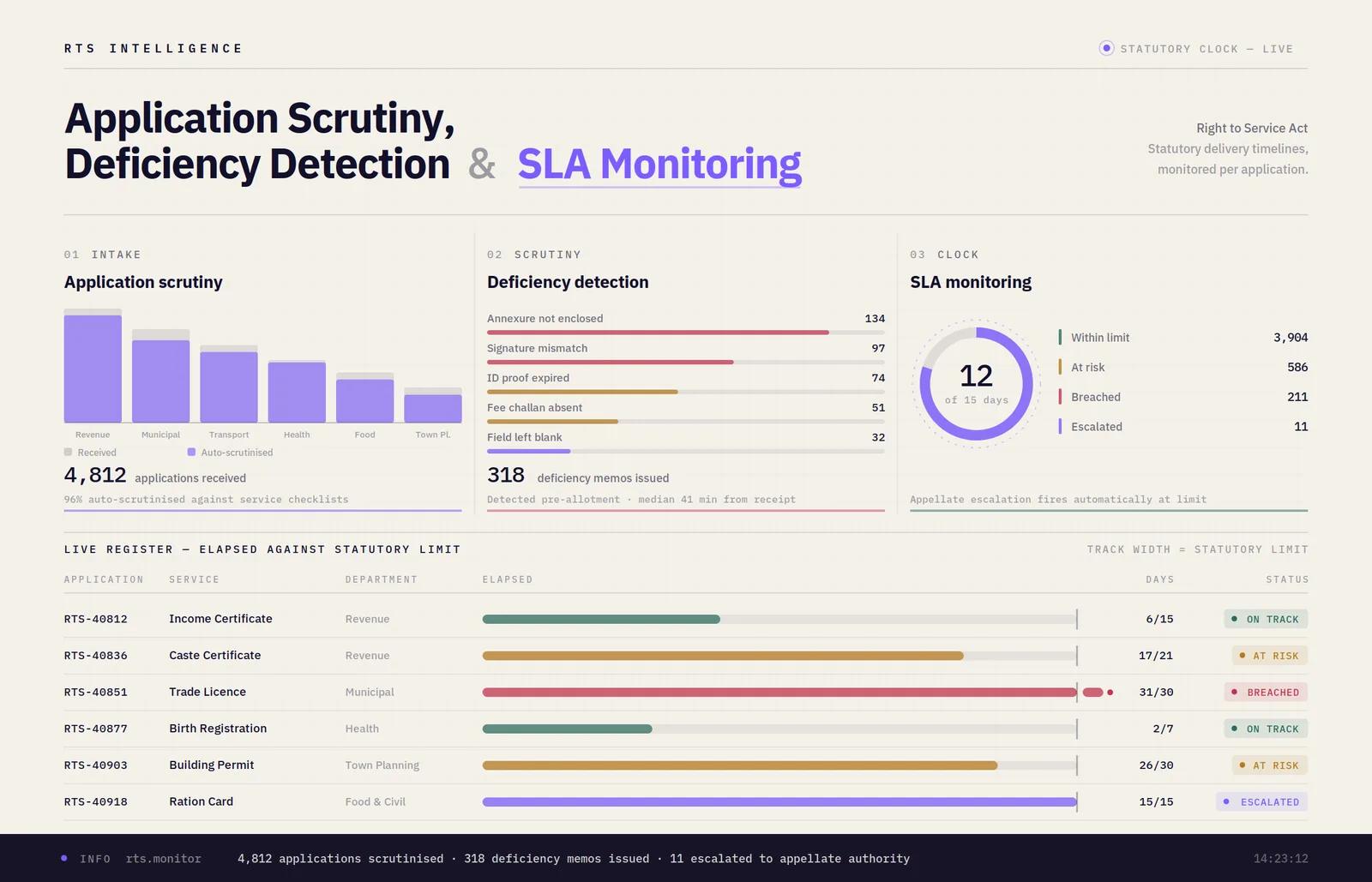
- Rules configured per service. Scheduled ingestion of applications fed service-wise rule and checklist configuration, rather than one hardcoded checklist.
- Deficiencies found early. Document-availability checks, field validation and consistency checks produced a completeness score and preliminary deficiency observations for every case.
- SLA risk, before the breach. Workflow and dependency monitoring predicted SLA breaches, flagged stuck and repeatedly returned cases, and generated officer-wise action lists.
Impact
Officials gained earlier visibility into incomplete applications and at-risk cases, with a framework that adapts across every Right to Services category.
- Faster preliminary scrutiny. Repetitive manual checking dropped and deficiencies were identified earlier in the application lifecycle.
- Clearer intervention priorities. Visibility into pending and at-risk cases helped officials act on the right files first.
- Consistent rule application. Service-delivery rules were applied more consistently across officers and departments, with insight into where and why cases stalled.
Capabilities
Document Intelligence · Rules-Based Validation · Workflow Analytics · SLA-Risk Prediction · Application Scrutiny · Public-Service Automation · Responsible Human-Assisted AI
Questions
What is RTS Intelligence?
RTS Intelligence is an assistive AI module that reviews Right to Services applications for missing documents, inconsistent information and SLA risk, and shows its findings to an officer before any formal action.
Does the AI approve or reject applications?
No. It generates observations only. Every acceptance, return or escalation is decided by an authorised officer.
Which services can it cover?
Licences, certificates, permissions, registrations and approvals, with checklists configured service by service.
Most applicants are not asking for special treatment. They are asking to be told what is missing before they have waited weeks to hear it.
allcontext.ai, from the RTS Intelligence case study
Applications stalling on missing documents?
See how assisted scrutiny flags deficiencies on day one. Book a discovery call or write to hello@allcontext.ai.